Showing posts with label repower. Show all posts

Wednesday, July 13, 2011

Ludicrous Speed

Since repowering Sojourn, I’ve taken it easy, rarely getting above 2000 RPM.  My knot meter isn’t working and was never calibrated, so I don’t actually know how fast that pushes her – perhaps 3.5-4 knots, obviously just shy of light speed.  Yesterday Annie and her friend Loren were begging to go to Jetty Island.  We only had about an hour and it’s about a half mile each way, so light speed was going to be too slow.  The river was calm, so we tied every thing down, took our seats and pushed Sojourns power lever all the way forward to, yes, ludicrous speed.

Up river, the GPS settled on 5.5 knots.  20 minutes later, it settled on 7.3 knots on the return course. So, ludicrous speed averaged 6.4kts on the GPS with the engine turning 3500-3600 RPM and no evidence of soot or smoke.  So for Islander 30 MKII and Bahama owners with Beta 14’s, if any others exist, here is a data point for you.

Incidentally, this sinks the transom to the point that the exhaust fitting, which is normally 4-5 inches above the water line, is completely submerged.  The Beta 14 came with a 2:1 ratio gear box and is spinning a 13X8 2 blade Michigan Sailor prop. 

Monday, May 30, 2011

Too Good to Be True, the Saga Continues

So, that which sunk a ship had other consequences.  Once I discovered that the engine had been under water, I resigned to the notion that all of the electronics had to be replaced and so it was true.  The final piece of electrical gear to go was the starter.  Surprisingly, it wasn’t the starter itself, but the solenoid. It developed an internal short and didn’t have enough pull to engage the bendix and close the contact to the starter.

Greg, a friend with scuba gear, volunteered to dive into the 49 degree water and change out her prop.  Just to say I helped, I dawned my wet suit and a snorkel and almost like a Loony Tunes character I was out of the water before my fins hit.  Brrrrrr!  Incidentally, on a near high rising tide, there wasn’t a hint of salt in the Everett marina.  So we dried off and I hit the starter.  The engine roared to life and then died. I only had the speed control set at perhaps 30%.

I decided that it was a governor problem, so I pulled the speed control plate to investigate.  Under it there was a bar, that was clearly part of the governor and was sticky.  I worked it with a screw driver2011-05-29_14-49-21_453 until it was moving freely.  I thought perhaps a piece of corrosion was making it sticky, which appeared to be the case. 

So, Carrie, the girls, and I took her out for her first sail since the repower.  It worked pretty well, but he engine stalled a couple of times at idle. We had a relaxing sail on a 72 degree light breeze under mostly overcast skies.  After the spring weather we’ve had, I had not complaints. Afterward, we proceeded to Jetty Island. This time, it wouldn’t rev up, so we limped back to Sojourn’s slip instead. 2011-05-30_14-41-39_498

Later that night, I took the fuel injection pump out.  What a mess! There was rust in it and one of the springs had shattered into a dozen pieces.  I can only surmise that corrosion caused stress risers which cause the spring to break.  I’m amazed at the number of pieces the spring is in and have no explanation. The rest of the pieces are still in it as I was fearful of not being able to put Humpty back together again in the absence of a clean work bench. It is Memorial day, so I’ll have to wait until later in the week to see what the damage to my wallet is going to be.

Sunday, May 15, 2011

Noise Comparison Beta vs. MD7a

I’m fortunate to have pretty good hearing.  While I can’t hear a dog whistle, at age 40, I still find old school CRT type televisions annoying because I can hear the scan frequency.  My wife, and most adults I’ve asked, have no idea what I’m talking about. 

It comes at a price though – I’m sensitive to noise in general.  With two notable exceptions, I find most machine noise to be annoying.  Being a mechanical engineer and former auto mechanic, machine noises that sound like something is loose or malfunctioning, or just shouldn’t be, are the worst. My old tired MD7a with it’s “missing the third jug timing” was one of those. (The MD7a has the cylinder timing of a 3 cylinder, with one of the cylinders missing.) So after reading all of the forums and sales literature about how quiet the Beta is, I was very excited to find a good deal on a Beta.

MD7a

So the Beta is installed and the jury has rendered a verdict.  Although I have access to it, it didn’t occur to me to take before and after noise measurements with a sound meter, so my phone will have to do.  Quantitatively, the Beta is quieter, but nothing to….well shout about.  Qualitatively, it sounds to this designer of machines for the last decade as a 2 cylinder diesel should, if a little

Beta 14
noisier than I would like. Here are some videos. That said, no effort has been made to add sound insulation (yet) in Sojourn and in fact feels like a lot of vibration is getting transmitted through the hull and reverberating in the open space in the lazarette. I’ll revisit this when I get to sound insulation on my rather lengthy to-do list.

Oh, and the two notable exceptions: A Ducati 900 Super Sport and Packard V-1650 often heard in a North American P-51 Mustang flyby.

Galloping Ghost at Reno (3 min video.) The video doesn’t do it justice.

Wednesday, May 4, 2011

Sojourn’s Exhaust

The Beta’s exhaust comes out on the opposite side of the prop shaft  as the old Volvo and thus my muffler.  I needed a tail pipe that went up about 8 inches, to starboard 9 inches and aft about 17 inches to the muffler. Moving the muffler is possible, but not attractive as it would encroach on storage space in the lazarette. To solve my geometry problem, I designed a tailpipe in Solidworks consisting of a flange, a bent piece of 1-5/8 stainless exhaust tubing, a 1-1/4 pipe nipple, and a 1/2 pipe nipple.  I made the flange myself and had Stan at Stan’s Header’s in Auburn bend the tube. I cut the threaded ends off the 2011-04-23_14-54-29_612nipples and milled a hole in the larger.  I then welded the parts together.  Voila.  After wrapping it with some exhaust lagging, the hole exhaust project cost me $125 and about 2 hours. 

As I’ve said before, I purchased Sojourn as a learning project and am getting my money’s worth.  On that note, I was surprised to find that my old tail pipe actually had evidence of rust, to the point of rot, from the outside than the inside. In fact, if you look closely, there is a hole in it. I have also noticed that every time I2011-04-29_11-39-15_804 started the engine, that the exhaust lagging would steam.  I’ve since learned that the lagging is hygroscopic (has an affinity for water) which causes it to absorb water from the air, of which there is much on a sailboat. Hopefully the stainless will last longer than the carbon steel did.

Other’s who have converted to Beta, will likely recognize that Beta recommends a 2” exhaust for this installation.  I decided to try to save a few hundred dollars and reuse the old exhaust.  If the 1-5/8 doesn’t keep me within allowable back pressure, I’ll have to upsize.  Stay tuned.

Friday, April 29, 2011

It’s Working!

I’m behind in postings as I’ve been sick and working on Sojourn. It isn’t done yet as there are still small details (like connecting it to a prop shaft) to finish, but I’m happy to report…..

It’s working. It’s working!

And it’s fantastic! There was no crawling half into the lazarette with a can of ether, no smoke, no smell, and no embarrassing oil sheen.  There was just a 10 second pause for the glow plugs, then voila. 

And to top off an already good evening….

2011-04-29_20-10-29_112

Monday, April 18, 2011

Four Feet Closer

One of the fringe benefits of my job is access to a rather well equipped machine shop.  The shaft line on the Beta sits about 1.9 inches lower than it does on the old Volvo and therefore the new Beta needs to sit 1.9 inches higher.  Beta Marine advertises that they have a solution for this, but having already purchased this on the secondary market, visions of hundred dollar bills danced in my head. 2011-04-17_11-32-10_861

I found a piece of 6 inch aluminum C channel and drew up some feet in Solidworks around this material.  I cut it into 5 inch lengths and a few hours on an mill and this is what I ended up with.

I was worried that the timber under the engine beds would be rotten after 37 years, so I wanted a good hold to the fiberglass itself.  I decided that six #14 stainless wood screws should do the trick. 2011-04-17_16-54-57_392

Despite a cold soggy morning, the afternoon turned out to be delightfully sunny and almost, dare I say, warm. Annie and I headed to the marina to install the new hardware. 

To my pleasant surprise, nice dry pink wood chips came out of all 24 of the drilled holes.  I wonder what species they used that might have pink wood.2011-04-17_16-49-05_781 If six screws was going to be enough in rotten wood, this felt very reassuringly solid.  After screwing down all four feet, I rigged the engine to the Halyard for the last time and set the engine on the new feet.  So, Sojourn is four feet closer to having a running Kubota power plant.

Monday, April 11, 2011

Forward Progress

2011-04-09_15-02-33_987-1We, here in the northwest, had a break from the dismal excuse for spring weather on Saturday.  It was one of the first dry days we’ve had in a while, not to mention one of the first this month above 50. Our good friend Bill was available for a quick afternoon trip, so I seized the opportunity and off to the marina with a shiny red engine and a sense of enthusiasm we went.

2011-04-09_15-53-18_61To solve the problem of handling the engine between the garage and trailer and then the dock, I made a frame out of 2X4 timber and strapped it to the engine with motorcycle straps.  The result was a akin to a double ended wheelbarrow, which worked very well. The problem of getting it from the dock into the cabin and subsequently into the engine compartment was solved for me by virtue of the fact that Sojourn is, after all, a sailboat.  We rigged the main halyard to the engine sitting on 2011-04-09_15-53-24_335the dock.  I manned the winch, while Bill and my slip neighbor, Matt, guided the engine over the gunnel and down the companion way.  Short on time, we left it there for the night.

2011-04-10_10-34-56_410Sunday, the weather returned to its less than spring-like dampness, wind and gray, but not so much to prevent me from moving the engine from the cabin sole to the engine compartment.  This went with out a hitch, even by myself.  I ran a motorcycle strap between the end of the mast and the halyard to keep the engine from swinging toward the mast.  The lifting eyes were ideally located on the2011-04-10_10-36-59_234 Beta and permitted me to get all four feet on the beds in one shot. To scoot it back into position and adjust the feet, I rigged it though the deck hatch and put some tension on the halyard.

Voila, a shiny red engine in its new home.  (Sorry, my final image was too fuzzy to post.  Stay tuned.)

Wednesday, April 6, 2011

That Which Didn’t Sink a Ship

I’m now finished with phase two of Sojourn’s repower project.  The engine bay is clean and painted and Sojourn is waiting to be powered by Kubota (in the absence of wind of course).2011-03-24_13-17-22_147

I cleaned the engine bay, first with Greased Lightning, which I’ve found to be a very good surfactant in the past, then simple green and scrub brush, vacuuming the resultant gray foam with a shop vac to keep it out of the bilge.  I then coated it with two coats of Interlux BilgeKote on two consecutive days.  The only two problems I had were that the shaft packing was dripping too fast for the bottle and the rag I placed under it and there were traces of grease showing up in the roller.  Time will tell if the latter causes any adhesion issues.2011-04-03_11-59-05_17

One thing I did in preparation was remove the shaft flange so that I could modify it. The Volvo had a metric bolt circle slightly different than the imperial one of the Technodrive. I would not bother to modify this eighty dollar part if I didn’t essentially have a machine shop at my disposal.

Getting to the subject and title of this post, I woke up in the middle of the night realizing that Sojourn’s slip is subject to river currents and there was nothing preventing the prop shaft from working its way out of the stuffing box should a current cause the prop to turn.  Could the bilge pump keep up with a 3/4 inch hole in the hull?  Perhaps for a while, but not something I wanted to learn empirically, so I stole away on my lunch break to check on it.  Thankfully, it hadn’t moved.  I installed a piece of hose and hose clamp on the prop shaft and headed back to work anticipating a better night’s sleep tonight. 

The next time an opportunity presents itself, I’ll have to remember to offer a little extra wine to the old man in the sea.

Thursday, March 31, 2011

Sojourn’s Repower Underway

I’ve embarked on a sojourn of a different sort – repowering Sojourn. As I write this, she leans slightly to starboard in her slip, burdened by 340 pounds of cast iron sitting on her cockpit seat. 2011-03-24_13-16-56_234

I had planned to get a chain fall, some additional muscle and some other tools to remove the old Volvo MD7A, but the decided to go down and get started. I disconnected the control cables, wiring, exhaust, fuel and cooling hoses.  I then removed the bolts from the motor mounts and prop coupling and the motor was free, save the forces of gravity and being something of a square peg behind a round hole – or was it the other way around? By calibrated eyeball, the opening was about 2 inches shorter than the distance from the bottom of the flywheel to the top of the valve cover.  Further, the flywheel was too low in the hole to get a three-jaw puller on it.

To expose the flywheel, I tied the main halyard to the alternator bracket and hoisted, tipping the engine up, giving me the clearance I was hoping for.  The three jaw puller I borrowed from work must have weighed 45 pounds and seemed adequate to remove the wheel from one of those earth movers you see on Big Machines. After applying most of the muscle and all of the cajones I had, it would not budge.  I had screwed so much energy into it that I was having visions of it popping off and subsequently harpooning the forward bulkhead.  In fact, I damaged the crankshaft stud pretty badly.2011-03-24_13-17-10_503

Plan B was to remove the valve cover, rockers and injector lines. Now, at least, it was a smaller peg.  And, it was halfway out of its hole.  I decided to keep going.  I tightened the halyard a little more and gave it a tug.  The engine practically popped onto the battery box.

The impatient man in me wanted to keep going so the engineer did a seat of the pants calculation.  340 pounds.  7/16ths halyard. 5 inch winch. 12 inch handle. Some friction. – about 70 pounds of armstrong.  I figure I give it at least 50 pounds of armstrong on the last crank when hoisting the sail.  A 7/16 line, even as old as this one should have 1000 pounds of breaking strength. I went for it.

The impatient man re-rigged the halyard, tied a line between the end of the boom and the halyard to keep the engine from swinging toward the mast and proceeded to crank the winch.  As soon as it pulled free of the battery box, the whole boat listed to starboard with the engine swinging likewise.  I think I heard a goose in a very good Homer Simpson voice say “Dohhhh!”  The impatient man tied a line between each of the cabin top winches and the halyard.  This worked very well. I continued cranking the winch as the old Volvo emerged from the companionway.

Before I knew it, Sojourn’s old engine (and perhaps someone’s new anchor) was sitting on the starboard cockpit seat and there was an  empty hole under the cockpit.2011-03-24_13-17-22_147

Saturday, March 26, 2011

That Which Sunk a Ship

IMAG0691Some time ago, I had been offered this Cal 34-2.  It was a bigger financial bite than I felt I could chew. A week after buying Sojourn I got an email.  The last line read, “28 years of memories gone aground on a lee shore during a midnight storm.”

IMAG0692She was tied to a mooring ball in the north part of Puget Sound. The three mooring lines all chaffed and then parted.  She ran aground.  She was a total loss save a few keepsakes rescued before going to the grinder.

IMAG0687

Friday, March 25, 2011

That Which Sinks Ships

It seems probable that I am the new owner of a slightly used sailboat engine, not because (as the previous owner claimed) it was under powered for the 36 foot sailboat it went into, but because the sailboat it was installed in sank!  Now that I’ve satisfied myself that the engine is still viable in spite of that, I’ve been pondering what might have caused the this boat to sink?

The timing alone offers some clues.  It had to happen in the last 4 months given the date of manufacture.  It likely happened in the last 2 months as repowers rarely happen overnight. I was told by the previous owner that it had been sitting for about a month.  Given his omission of the subject at hand, who knows?  But,given its placement in the shop behind some of the kind of stuff that seems to collect in shops, perhaps. That places the time of sinking in January or February.  Perhaps it was a Christmas break project.

Was the sinking related to the repower itself?  On one hand, there are a lot of external forces that might cause a boat to sink in Puget Sound in the middle of winter.  We get fairly intense wind storms and had at least two spells of temperatures in the 20’s this year  In fact, the Everett marina was frozen solid twice that I observed this winter.   Perhaps the docking lines chafed to the point of parting and it ran aground. Perhaps something froze and broke. 

On the other hand, this was likely a 30 year old boat as suggested by the fact that it was getting a repower.  What are the chances of it surviving 30 years, only to sink during or right after a repower? As I would hate to be the 2nd owner of this engine to suffer this fate, this bears consideration. By the way, does any one know if the old man in the sea likes red wine as an offering? 

If I make the assumption that it was related to the repower, the next question is: did it sink at the dock or underway?  I’m a freshly minted sailboat owner and, at least this winter, was eager as they come. I only made it about 1 in 6 weeks in the middle of winter.

So, assuming the dock, possibilities that come to mind are: A makeshift plug for the prop shaft came loose.   The battery was disconnected and an unnoticed slow leak caused her demise as the sump pump sat idle. A coolant hose was propped up above the water line, only to fall with the motion of a wave with its seacock open.  Perhaps the exhaust transom fitting hadn't been secured and a storm came up.   All things that I am going to pay attention to as I embark on Sojourn’s repower to be sure.   Which one caused the actual demise?  Perhaps Holmes could do a better job of sleuthing, but my guess is it was a combination of some leak due to a temporary situation with the repower and a turned off or disconnected sump pump.

Experienced sailors and vicarious sojourners alike, it would be fun to read your thoughts on this.  Please comment below.

My curiosity led me to Google it.  Here is the first link I found that opened quickly.   http://auburnpub.com/lifestyles/article_4428699d-e5f2-5e9f-b4ea-28bb54a3860e.html.

In summary, that which sinks sailboats most often is below water line fittings, of which I have seven – that I know of.

Tuesday, March 22, 2011

Too Good to Be True

I’ve both found screaming deals and wasted time and money on Craigslist.  But, on balance, I have had a favorable experience. This deal…well, time will tell. 
Sojourn’s 13 horsepower, 1974 Volvo Penta MD7A is tired. She smokes when cold.  She doesn’t start without a can of assistance if the outside temperature is below 50.  Incidentally, I fearlessly bought her with two thoughts in mind.  First, that I can rebuild nearly anything.  Second, this is a hands on learning experience.  I didn’t fully appreciate the scope of the second.  The jury can decide which of those the cost of Volvo parts applies to most.
Video of Sojourn’s old MD7A
So, for the last couple of months, I’ve been monitoring Craigslist to get a feel for future repower possibilities. I wasn’t planning on acting before next winter, just getting a feel for the market and possibilities.  Then, to my surprise, a Beta14 showed up one morning at an attractive price.  I nearly sprained my pinky hitting send on my reply email! A few hours later, I was standing in front of it. Beauty is in the eye of the beholder.  I’m an engineer and a sailboat owner and it was shiny and red and beautiful!
The alleged story was that it was under powered for the 36 foot boat it had been installed in, which seemed at least logical.  After gathering a battery, a cable, a fuel line and discovering that the switch was corroded there was one glorious puff of black smoke and then musical, mechanical, diesel purring.
All of the fluids looked as one would expect in a brand new engine. I only had three reservations which, in the end, didn’t prevent me from buying it.  1. Was it stolen? 2. It had some unusual corrosion, at least to my amateur eyes. 3. Last, but not least, was it too good to be true?
On the first point, the transaction took place at a business with lots of employee and non employee onlookers, so I dismissed it.  On the second, I chalked up to salt air.  On the final, this is where it gets interesting.
I brought it home, fired it up and started going through it.  At first, it appeared it might even be a better deal than I thought.  I found the date of manufacture sticker.  10/10 – only 4 months old.  I also noticed that all of the paint was still on the pulley grooves.  I ran it until the thermostat opened.  The previously virgin looking oil turned a little milky.  I’ve seen this before in engines that don’t get fully warmed up often enough, so I wasn’t alarmed.  I changed it, brought it back up to temperature with no more milk.  I also noticed that the pulley grooves were now partially black – this motor didn’t have much time on it at all.
2011-03-20_16-34-55_982
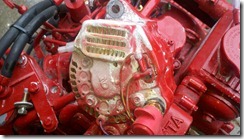
Next, I moved on to the electrical.  The alternator didn’t work. They say a picture is worth a thousand words.  It only took me a minute to realize this picture was saying “gurgle gurgle gurgle.” I took it apart to find the conductors between the brushes, the regulator and the diodes were gone!  There were only rusty nubs where the conductors used to penetrate the substrates of the various components.
Experienced sailors no doubt have filled in the blanks.  Later, my friend Ben, an experienced sailor, confirmed the worst of the three scenarios running through my mind - the boat had sunk during or after repower.  He had in fact concluded that upon first inspection, but felt is was still a good deal and didn’t want to burst my bubble so he kept it to himself.
So, in answer to the third point, yes.  My fantastic craigslist find, in all likelihood, went down with a ship.  Time will tell if it turns out to be recovered treasure.